
Written by: Angela Derrick, Ph.D. & Susan McClanahan, Ph.D.
Date Posted: December 28, 2025 4:17 am

Traditional New Year’s resolutions often fail because they rely on pressure and perfection. Here are healthier, research-informed alternatives that support mental health.
As the year winds down, the talk about resolutions is starting to heat up.
You know how it goes:
The influence of this messaging is everywhere. From advertising to social media feeds:
From conversations with friends and family, to the content we consume:
By mid-January, many of us have not transformed. We have exhausted ourselves and are quietly discouraged. It’s no wonder we can’t stick to something that was never designed to be sustainable in the first place.
Here is the part that often gets overlooked. Resolutions tend to fail not because individuals lack discipline, but because change does not thrive, and is actually less likely, under pressure, perfection, or shame.
If you are interested in stepping out of resolution culture this year, here are ten creative and supportive alternatives for real hope and health in 2026.
Instead of a list of goals, choose one word that reflects how you want to move through the year. Words like steadiness, curiosity, rest, or clarity offer direction without turning your life into a performance review.
Rules invite rebellion or collapse. Intentions invite reflection.
“I intend to notice when I am overwhelmed” creates space.
“I will find the magic solution to never feel overwhelmed again” creates pressure.
Resolutions thrive on more.
Consider what you want less of instead.
Twelve months is a long time to stay motivated. Choosing one small focus per month allows room for life to change without turning flexibility into self-abandonment. Keep it small and allow for imperfection. Gently shift or update your focus as needed, monthly, daily, or in the moment.
For example, one of our colleagues created a list from a deck of value cards that have served as guides for decision-making and motivation. Her top values are wisdom, inner strength, creativity, courage, and compassion. She uses these values to guide her actions and focus her intentions. (Ask your therapist to take you through this values exercise to determine your list)
Instead of tracking productivity or perfection, pay attention to what helps you feel grounded. Notice which routines restore you and which interactions drain you, and let that information guide your choices.
Try asking a different question. Instead of “What is wrong with me?” ask, “What support would help me right now?” Support creates space for change, while self-criticism reliably undermines it.
You do not need to overhaul your life. One thoughtful boundary around work, relationships, or digital space can quietly reshape your year. Small, intentional shifts often create the most sustainable change.
Not something you must do every day, but something you can come back to. Walking. Writing. Therapy. Movement. Let it be a refuge, not another obligation. Allow it to support you in the moments when you need steadiness rather than structure.
Progress is not always visible or linear. Sometimes it looks like resting sooner, asking for help, or staying connected to yourself during difficult moments. It can show up as noticing your limits, responding with more kindness, or choosing steadiness over pushing through. These gentle shifts matter, even when they aren’t outwardly noticeable.
This may be the most countercultural choice of all. In a culture that prizes constant improvement and self-correction, noticing how you speak to yourself when things do not go as planned can be transformative. Pay attention to your inner tone in moments of disappointment or strain, and practice responding with care rather than criticism. Over time, this shift can reduce stress, increase resilience, and create space for steadier growth.
Dr. Angela Derrick notes, “I love teaching clients that self-compassion is a skill that can be practiced and learned over time. It’s not just “you have it or you don’t” which is often what clients believe coming in the door. It is rewarding to help clients develop a healthier relationship with themselves in this way and to watch as it becomes more natural and intuitive for them over time. If you are truly being kind to yourself, you are going to set thoughtful and realistic intentions for yourself, not goals seeking radical transformation!”
All-or-Nothing Thinking Undermines Behavior Change
Research in cognitive psychology shows that rigid goals often trigger black-and-white thinking. When people inevitably miss a day or fall short, they are more likely to turn toward self-criticism and abandon the goal altogether.
This pattern is sometimes referred to as the “what-the-hell effect.” Once a streak is broken, shame tends to take over and motivation drops sharply. People tend to say things to themselves like, “why does it matter” or “I’ll just start again tomorrow.”
In contrast, self-compassion combined with flexible goals creates healthier, more sustainable outcomes than perfectionistic goals fueled by criticism, because they allow for recovery rather than collapse.
Willpower Is a Limited Resource
Studies in self-regulation show that willpower is finite, especially during periods of stress, fatigue, or emotional load. January often arrives with depleted energy following the holidays, disrupted routines, financial strain, and seasonal shifts in mood.
Resolutions that depend primarily on self-control, rather than environmental or emotional support, are less likely to last.
Behavior change is more sustainable when it’s supported by structure, supportive habits, and compassion, rather than relying on sheer effort alone.
Resolutions Focus on Outcomes Rather than the Actual Systems that Lead to Progress
Behavioral science consistently finds that focusing on outcomes like weight loss, productivity, or performance is less effective than focusing on creating the systems and processes that will facilitate progress.
For example:
Resolutions tend to emphasize results rather than daily supports, which makes them fragile and prone to failure.
Shame Is a Poor Motivator
Neuroscience research shows that shame activates threat responses in the brain, increasing avoidance and reducing problem-solving capacity.
Many resolutions are framed around self-criticism. As though our bodies are a problem to be solved, or our habits and self-discipline are broken and in need of fixing.
Goals driven by shame may produce short bursts of effort, but it rarely leads to sustainable change.
For example, research shows that 95% of diets fail, yet society continues to frame this as a personal weakness or a lack of self-discipline. Now that GLP-1’s are helping many, it is common to hear those same people express the shaming position that individuals taking these medicines are just hitting the “easy” button.
Shame does not work whether it comes from society, people we know, or ourselves.
The Calendar Effect Is Misleading
There is nothing psychologically special about January 1. Research on behavior change suggests that people do better when goals emerge from readiness, rather than arbitrary deadlines.
The cultural pressure to “start fresh” can push people into commitments they are not resourced to maintain, increasing the likelihood of failure.
Identity-Based Goals Create Pressure
When resolutions are tied to identity, failure feels personal.
“I am not disciplined.”
“I always quit.”
“I cannot stick with anything.”
Studies show that when goals threaten identity rather than support it, people disengage faster to protect their sense of self.
Life Happens
Long-term behavior change research consistently shows that stress, illness, caregiving demands, and work pressures derail rigid plans.
Resolutions often assume stable conditions. Human lives are rarely stable.
Goals that allow adaptation survive real life. Rigid ones do not.
The science consistently supports:
In other words, the opposite of most resolution culture.
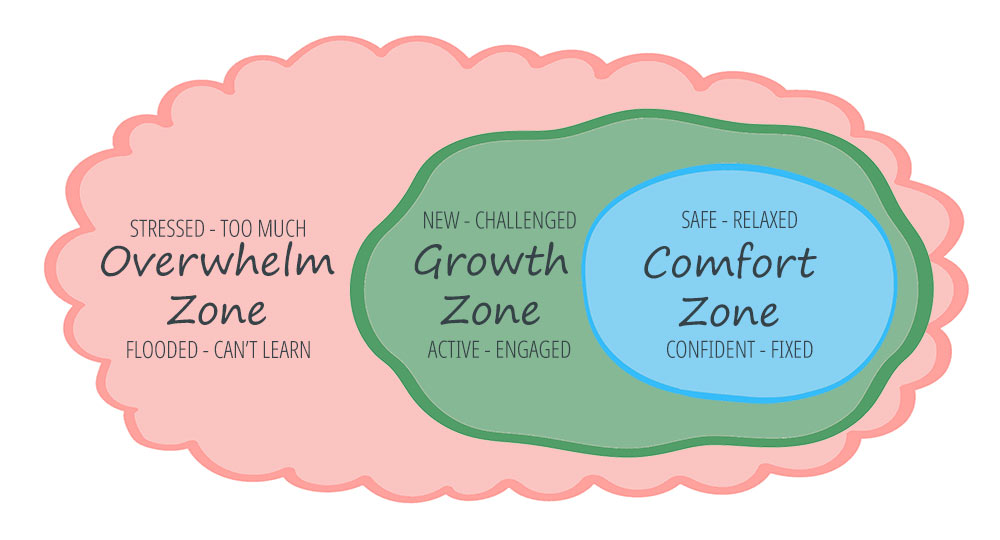
Creating achievable goals supports mental health because the nervous system responds best to experiences of safety, success, and follow-through. When goals are realistic and flexible, they help build trust in yourself rather than pressure to perform. This keeps us within the comfort and growth zones that are so important for health and well-being.
Each small step completed reinforces confidence and stability. In contrast, overly ambitious goals often activate stress, self-criticism, and avoidance, quickly pushing us into an overwhelm zone that can halt growth and trigger freeze or flight responses. Over time, repeated experiences in the green zone of “I can do this” strengthen emotional regulation, motivation, and resilience in ways that perfection-driven goals simply do not.
Psychological growth is not about dramatic change or constant self-improvement. It’s about building awareness, learning how to respond differently to challenges, and developing habits that support well-being in everyday life. Achievable goals create space for reflection and adjustment rather than setting you up for failure. They allow growth to unfold gradually, with compassion and in alignment with your values.
This kind of steady progress strengthens mental health by honoring both where you are now and where you’re headed, without asking you to abandon yourself along the way.
If resolutions have not worked for you in the past, that is not a personal failure. It is a design flaw.
As the new year approaches, you do not need a dramatic reinvention. You do not need to declare war on yourself to grow.
You may simply need more support for the person you already are.
Here’s to entering the new year with a little humor, a little honesty, and far less pressure to become someone else overnight.
At SpringSource, we believe meaningful change grows through support, not pressure. If the start of a new year brings reflection, uncertainty, or a desire to approach things differently, you do not have to navigate that alone.
Our clinicians work alongside you to build insight, steadiness, and sustainable tools for caring for your mental and emotional well-being. Whether you are looking to reduce anxiety, navigate life transitions, explore patterns that no longer serve you, or simply feel more grounded in your daily life, therapy can be a supportive place to begin.
You do not need a resolution to start therapy. You just need a willingness to show up as you are.
If you are curious about working with us, we invite you to reach out through our contact form, schedule a complimentary 15-minute consultation, or email us to learn more about our services.
Support can be part of your year, without becoming another thing to get right.



We provide in-person therapy in Northbrook and Chicago, with telehealth therapy available throughout Illinois.
© 2026 SpringSource: Eating, Weight & Mood Disorders | Designed by 800Commerce
Serving: Chicagoland Area, Northbrook, Evanston, Arlington Heights, Glenview, Skokie, Palatine, Elgin, Cicero, Schaumburg, Des Plaines, Orland Park, and throughout Illinois