
Written by: Angela Derrick, Ph.D. & Susan McClanahan, Ph.D.
Date Posted: March 30, 2026 1:50 am
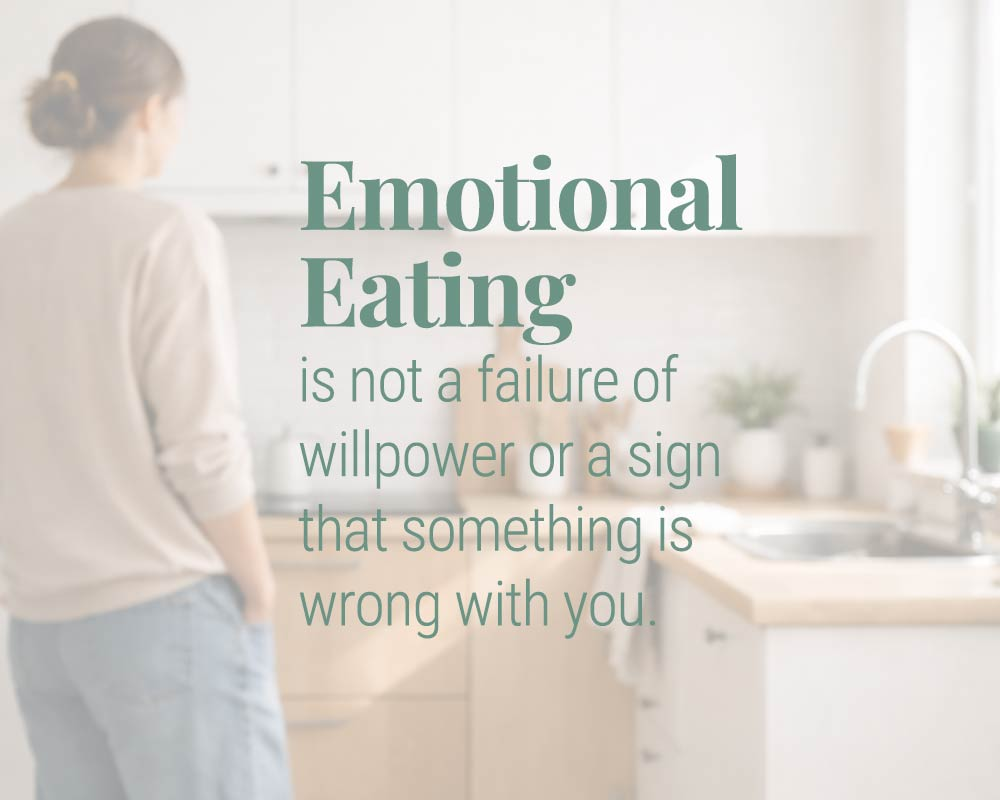
For many people, emotional eating is something they struggle with in secret.
It might look like reaching for food after a long day, eating past fullness without fully realizing it in the moment, or feeling pulled toward certain foods when emotions feel overwhelming, dull, or hard to describe. Sometimes people will say “I’m eating my feelings,” often with a tone of frustration or self-judgment.
Emotional eating is not a failure of willpower. It is often a reflection of how your system has learned to cope. It is not a sign that something is wrong with you.
At SpringSource: Eating, Weight & Mood Disorders, we often help people understand that emotional eating is not a problem to eliminate, but a pattern to understand and modify. When we slow down and get curious about it, emotional eating begins to make sense in ways that can feel relieving rather than shame-inducing.
The challenge is not that eating and emotions are connected. The challenge is when this becomes one of the only ways your system knows how to cope.
Food and emotions are deeply connected.
From the very beginning of life, nourishment is not just about calories or nutrients. It is also about comfort, safety, connection, and regulation. Over time, the brain and body learn that food can shift emotional states, often quickly and reliably.
After a difficult conversation or an overwhelming day, you may find yourself in the kitchen, not out of hunger, but out of a need to feel a little more grounded.
At times, you might notice yourself opening and closing cabinets or the refrigerator, searching without quite knowing what you’re looking for. This can be a signal that something else is needed, whether that’s rest, comfort, or a moment to pause.
For many adults, especially those balancing work, relationships, and caregiving, food becomes one of the few accessible ways to pause, soothe, or feel something different.
Emotional eating can serve many purposes:
● calming anxiety
● softening loneliness
● creating a sense of reward or relief
● helping to avoid or numb difficult emotions
● providing structure in moments that feel unstructured or overwhelming
None of this is accidental. It is adaptive.
For some people, eating in response to emotions is simply part of life and doesn’t feel particularly problematic.
For others, it can feel much more complicated, bringing up shame, a sense of being out of control, or a desire to feel more steady in their relationship with food.
Emotional eating may begin to feel more concerning when it is accompanied by distress, self-criticism, or a sense that your relationship with food is becoming harder to understand or manage.
The challenge is not that eating and emotions are connected. The challenge is when this becomes one of the only ways your system knows how to cope.
“Eating my feelings” is often less about a lack of discipline and more about a lack of space, language, or support for emotional processing.
You may have heard or used the phrase “eating my feelings,” which often describes something much more complex than it sounds.
This phrase can reflect moments when emotions feel:
● too big
● too fast
● too unclear
● overwhelming
● unsupported
In these moments, food can act as a kind of emotional relief. It gives the body something concrete to do when the internal experience feels hard to process, and numbing, whether conscious or unconscious, becomes the goal.
For many individuals who feel distress over emotional eating, there may not have been much space earlier in life to feel or express emotions fully. Productivity, responsibility, or caretaking may have taken priority. Over time, emotions do not disappear. They simply find other outlets.
Food is one of the most accessible.
So “eating my feelings” is often less about a lack of discipline and more about a lack of space, language, or support for emotional processing.
For many people, stress is not just occasional. It is ongoing. That can make stress and eating patterns deeply intertwined.
One of the most powerful drivers of emotional eating is stress.
When the nervous system is activated, whether from work pressure, relationship strain, or the cumulative weight of daily responsibilities, the body looks for ways to regulate itself, and food can become a quick and effective option.
Stress can lead to:
● increased cravings, especially for quick energy foods
● a sense of urgency or impulsivity around eating
● difficulty noticing fullness or satisfaction
● cycles of restriction during the day and eating at night
These stress inflection points are not just psychological. They are physiological.
Chronic stress increases cortisol, impacts hunger hormones, and reduces the capacity for thoughtful decision-making. When the body is depleted or overstimulated, eating can become a fast and effective way to shift internal states.
For many people, stress is not just occasional. It is ongoing. That can make stress and eating patterns deeply intertwined.

In a culture that prioritizes productivity and constant stimulation, stillness can feel uncomfortable or even unsettling. Food can quickly fill that space.
Eating out of boredom is a common experience, but boredom itself is often misunderstood.
What people describe as boredom is frequently something else entirely:
● emotional flatness
● disconnection from self
● lack of meaningful engagement
● avoidance of something uncomfortable
For some people, especially those who are used to a high level of stimulation or intensity, moments of calm or low demand can feel unfamiliar. That sense of quiet can easily be interpreted as boredom.
In a culture that prioritizes productivity and constant stimulation, stillness can feel uncomfortable or even unsettling. Food can quickly fill that space.
For some, eating becomes a way to:
● create stimulation
● mark time
● soothe restlessness
● reconnect with sensation
Especially for high-achieving individuals, boredom can feel like something to fix rather than something to explore. Over time, eating can become a familiar and automatic response.
But underneath what we call boredom is often a deeper question about meaning, connection, or emotional presence.
Not all emotional eating is a concern.
Not all emotional eating is a concern.
At times, everyone eats in response to emotions. Celebrating, comforting, coping, and connecting through food are all part of being human.
When you are able to pause and make conscious decisions about what, when, and how much to eat, including moments of self-soothing, emotional eating is often not a problem.
When, however, you are automatically going through the motions and not consciously aware or making choices and decisions, you may begin to experience distress that impacts the quality of your daily life and routines.
For some individuals, emotional eating may become more frequent and intense. People begin to describe themselves as an “overeater,” often with a great deal of shame attached to that label.
What distinguishes a pattern from a moment often includes:
● feeling out of control around food
● eating past fullness regularly
● cycles of restriction followed by eating
● increasing preoccupation with food
● emotional distress before, during, or after eating
It is important to approach this with care. Labels like “overeater” can reinforce shame and make it harder to understand what is actually happening.
What matters more is understanding the function of the behavior rather than judging it.
Some individuals notice that their relationship with food becomes more consuming over time.
They may feel:
● constantly preoccupied with food
● stuck in cycles of control and loss of control
● rigid around eating rules or patterns
● anxious when not following certain food behaviors
In popular language, this is sometimes referred to as obsessive food disorder. While this is not a formal clinical diagnosis, it often reflects cognitive patterns that overlap with recognized eating disorders or disordered eating behaviors.
What is important here is not the label, but the experience.
When food begins to take up significant mental and emotional space, it is often a sign that something deeper is asking for attention. This might include unmet emotional needs, chronic stress, struggles with self-image, or long-standing relational patterns.
Understanding this can shift the focus from trying to control food to understanding what food has come to represent.
Dr. Angela Derrick notes, “Preoccupation with food is a frequent experience for individuals with eating disorders. In treatment, they often become sad when they realize how much of their mental energy and time is allotted to trying to control their diet, exercise and body. They start to wonder, what might I think about, enjoy, or accomplish if I was able to turn my mind to other things? This moment can signal a powerful shift in eating disorder recovery.”
Without understanding what emotional eating is doing for you, attempts to control it often intensify the pattern rather than resolve it.
Many people search for ways to curb emotional eating, hoping for strategies that will help them stop.
While this makes sense, it can also miss something important.
If emotional eating is serving a purpose, even if it is imperfect, then simply trying to eliminate it can create a new kind of struggle. Often, this leads to:
● increased restriction
● heightened cravings
● cycles of control and rebound eating
● more self-criticism
The issue is not a lack of discipline. It is that the strategy is incomplete.
Without understanding what emotional eating is doing for you, attempts to control it often intensify the pattern rather than resolve it.
The goal is not necessarily to eliminate emotional eating entirely. The goal is to understand what it is doing for you so you can expand your options for coping.
A more effective approach to curbing stress eating begins with expanding, not restricting, your options.
This includes:
● increasing awareness of emotional and physical cues
● identifying patterns without judgment
● building alternative ways to regulate stress
● creating more consistent and supportive eating rhythms
This does not mean replacing food with “better” coping skills in a rigid way. It means gradually developing flexibility.
Some examples might include:
● pausing briefly before eating to notice what you are feeling
● incorporating small moments of rest or regulation throughout the day
● exploring what your body actually needs in that moment
● allowing eating without immediately labeling it as a problem
Over time, this approach helps reduce urgency and increase choice.
At SpringSource, we approach emotional eating through a compassionate, relational, and evidence-based lens.
This means:
● understanding behaviors in context
● addressing underlying emotional and psychological patterns
● reducing shame rather than reinforcing it
● supporting sustainable, meaningful change
For many adults, emotional eating is connected to larger themes, including:
● anxiety and mood patterns
● family of origin issues
● identity and life transitions
● body image and weight experiences
● the cumulative impact of stress and emotional labor
Rather than focusing only on food, therapy creates space to understand the full picture.
If you find yourself struggling with emotional eating, it can be easy to feel frustrated or discouraged.
But what if, instead of seeing it as something to fix, you began to see it as something to understand?
Your patterns around food are not random. They are shaped by your history, your environment, your relationships, and your nervous system.
They are communicating something.
When you begin to listen with curiosity instead of judgment, new possibilities open up. Change becomes less about control and more about connection.
For many people, emotional eating is not the problem. It is the signal.
At SpringSource: Eating, Weight & Mood Disorders, we specialize in helping individuals understand and shift their relationship with food in a way that feels sustainable and compassionate.
Our approach integrates:
● evidence-based therapies such as CBT, ACT, and DBT
● relational and attachment-focused work
● a weight-inclusive, non-judgmental framework
● support for eating disorders, emotional eating, and body image concerns
● specialized care for individuals navigating stress, life transitions, and GLP-1 treatment
We offer in-person therapy in Chicago and Northbrook, with virtual therapy available throughout Illinois.
If you’re ready to better understand your relationship with food and develop new ways of supporting yourself, we invite you to schedule a free 15-minute consultation.
You don’t have to figure this out on your own.



We provide in-person therapy in Northbrook and Chicago, with telehealth therapy available throughout Illinois.
© 2026 SpringSource: Eating, Weight & Mood Disorders | Designed by 800Commerce
Serving: Chicagoland Area, Northbrook, Evanston, Arlington Heights, Glenview, Skokie, Palatine, Elgin, Cicero, Schaumburg, Des Plaines, Orland Park, and throughout Illinois