
Written by: Angela Derrick, Ph.D. & Susan McClanahan, Ph.D.
Date Posted: January 14, 2026 4:15 pm
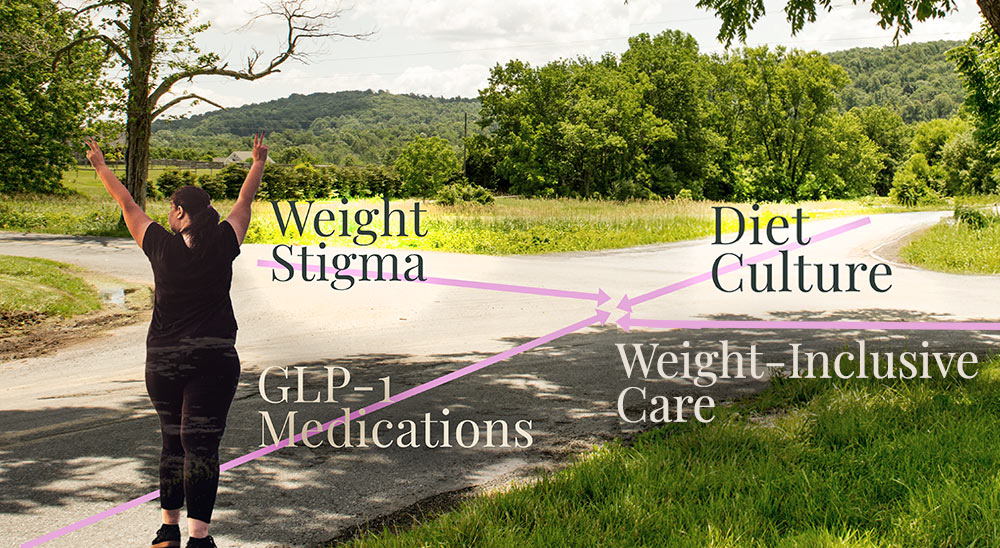
Providing Weight-Inclusive Mental Health Care in the GLP-1 era
If you are reading this while navigating questions about your body, your health, or your relationship with food, you are not alone. Many people have arrived at this moment carrying mixed messages and a lifetime of effort, hope, and disappointment. These struggles are widely shared, often generational, and run very deep both in our personal lives and the culture at large.
With the hope that GLP-1 weight management medications (Zepbound, Wegovy) offer, you might be considering them or already taking one. At the same time, you may be committed to body respect, or thoroughly tired of tying your worth to a number on the scale. No matter where you are, you deserve healthcare and mental health support that respects your full humanity.
This conversation isn’t about telling you what to do with your body. It’s about making space for understanding, choice, and support in a culture that too often sees your body as a problem to be solved.
We want to start by stating emphatically that if any of the following actually worked across the population, we would likely not be having this conversation:
These approaches have not produced collective health. They have produced cycles of restriction and rebound, mistrust in one’s own body, and a healthcare system that too often conflates thinness with virtue and fatness with failure.
The emergence of GLP-1 medications does not erase this history. It enters it. And that is where the intersection with diet culture, weight stigma, and weight-inclusive mental healthcare becomes both complicated and essential.

Weight inclusivity principles emphasize equitable access to care, respect for body diversity, and behaviors that support physical and psychological health across the full spectrum of bodies.
Core principles include:
Decades of research demonstrate that health behaviors such as nutrition quality, physical activity, sleep, and stress regulation are more predictive of long-term outcomes than weight alone.
Weight-inclusive care seeks to:
This approach aims to restore trust in the body and reduce the harm caused by chronic dieting and internalized bias.
In The New Food Fight, Robyn O. Pashby, Marian Tanofsky-Kraff, Natasha L. Burke, and Natasha A. Schvey explore how contemporary conversations about weight, health, and eating are shaped by a collision of forces, including:
The authors emphasize that even well-intentioned interventions can reinforce stigma when thinness remains the implicit goal. This tension becomes especially visible in the era of GLP-1 medications. For some, these treatments represent well-deserved relief from relentless biological pressures around appetite, metabolism, and weight. For others, they raise concern that weight loss is once again being framed as the central marker of health, potentially undermining weight-inclusive principles and reviving familiar narratives of “fixing” bodies.
The controversy is not about whether GLP-1s can be medically useful. It is about the cultural meaning they carry. When these medications are positioned as a moral solution to body size, they risk reinforcing the very stigma we are seeking to dismantle. Pashby and colleagues caution that without a parallel shift in how we define health, new tools may simply reproduce old harms in more sophisticated forms.
A weight-inclusive perspective invites a more nuanced question: how can GLP-1s be offered, when appropriate, in ways that preserve autonomy, resist shame, and affirm that care is deserved regardless of size or outcome. This framing does not reject medical innovation. It insists that it be integrated within an ethic of dignity, complexity, and psychological safety.
In The New Food Fight, Pashby and her colleagues also challenge the cultural stereotype that eating disorders belong exclusively to ultra-thin, young, white girls. In reality, most people with eating disorders live in larger bodies and span every age, race, gender, and socioeconomic group. The authors emphasize that this narrow reference obscures suffering, prevents or delays diagnosis, and leaves many people unseen in both medical and mental health settings.
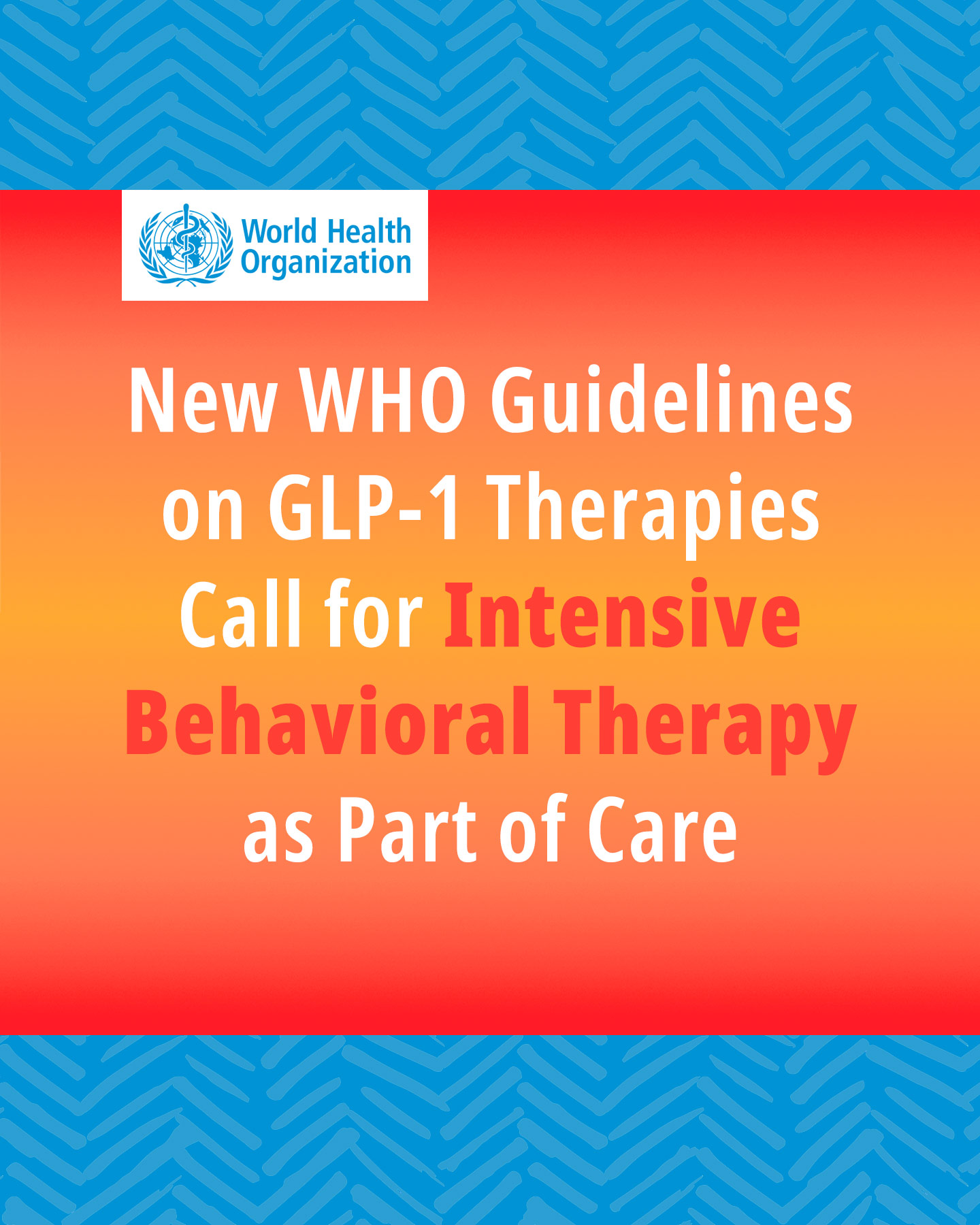
The World Health Organization has recently updated its guidance on the use of GLP-1 medications in treating obesity, naming it a chronic, relapsing disease and calling for care that extends beyond medication alone. Central to this guidance is the recognition that lasting well-being is not built solely through prescriptions. Psychological and behavioral support matters.
In these recommendations, the WHO highlights the value of Intensive Behavioral Therapy (IBT) as a core part of comprehensive care. IBT is not about rigid rules or “fixing” you. It is a structured, evidence-based form of therapy designed to help people build practical and emotional skills that support long-term health in ways that are humane and sustainable.
This work may include:
What this guidance affirms is something many people already feel in their bones: change that lasts is not rooted in shame. It grows from understanding, safety, and support. Care that honors both the biological and emotional dimensions of health makes room for you to move forward without abandoning yourself along the way.

At SpringSource, we offer care that aligns with WHO guidelines and a broader understanding of health. For some people, GLP-1 medications can be a helpful tool in addressing metabolic and appetite-related changes. Therapy offers something different and equally important. It creates space to explore the emotional layers that medications can’t reach.
In our work together, clients often focus on easing shame, making sense of long-standing patterns around food and body, navigating shifts in self-image, and slowly rebuilding trust in themselves. We help you develop tools that support emotional well-being and meaningful, lasting change in ways that feel humane and sustainable.
We are a size-inclusive practice with deep experience supporting people across the full spectrum of body shapes and sizes. Our approach is affirming, compassionate, and non-judgmental. While medication may address biological factors, we provide psychological support for the inner work that sustains growth over time.
With a shared commitment to whole-person care, SpringSource offers thoughtful, individualized mental health care that is respectful, attuned, and grounded in your unique needs.
Led by Susan McClanahan, PhD, Co-Founder & Managing Partner
Announcing a process-oriented group for individuals in higher-weight bodies navigating eating disorders, body image distress, shame, and the emotional impact of weight-related stigma. Dr. McClanahan brings more than two decades of leadership in eating disorder treatment. As the founder of Chicago’s first intensive outpatient program for eating, mood, and anxiety disorders and a former Chief Clinical Officer and Senior Clinical Advisor for ERC and Pathlight, she has helped shape how higher-weight eating disorders are recognized and treated nationwide. This group reflects her longstanding commitment to care that is both evidence-based and deeply humane.
Weight stigma is the social devaluation of people based on body size. It shows up in subtle glances, unsolicited advice, medical appointments that begin and end with weight, and the underlying assumption that a person’s body tells a moral story about who they are.
Diet culture is the system that makes this stigma feel normal. It is the belief structure that equates thinness with health, discipline, and worth, and treats larger bodies as problems to be solved. It teaches us, often from a very young age, to distrust our hunger, to fear fullness, and to believe that our bodies must be controlled in order to be acceptable.
This harm is not just theoretical. Research consistently shows that diets often fail long-term for the vast majority of people, with approximately 95 percent of individuals regaining lost weight. Additionally, the repeated cycles of restriction and regain increase the risk of disordered eating, depression, anxiety, and shame. Yet when weight loss does not last, the failure is framed as personal rather than systemic. People are told they lack willpower, discipline, or motivation. This narrative obscures the complex biological, genetic, hormonal, social, and psychological factors that shape body size and appetite. It also creates a climate in which people learn to wage war on their own bodies, often at great emotional cost.
Diet culture is especially powerful because it often disguises itself as health. Messages about “clean eating,” “earning” food through exercise, or “fixing” the body are framed as responsible and virtuous. Over time, many people begin to experience movement as punishment, food as a moral test, and their bodies as projects that are perpetually unfinished. The result is not greater well-being. It is a chronic sense of inadequacy and a rupture in trust between people and their own internal cues.

In the GLP-1 era, these dynamics matter even more. New medical tools do not exist in a cultural vacuum. Without an intentional shift in how we define health, weight loss risks being reinstated as the central measure of success.
At the same time, it is important to say clearly that wanting to lose weight does not make someone shallow, misguided, or morally suspect. Many people meet clinical criteria for these medications and seek them for deeply personal, valid reasons that include physical comfort, medical concerns, mobility, relief from constant food preoccupation, or a desire for change after years of struggle.
A weight-inclusive lens does not require anyone to abandon their goals. It asks that care be offered in a way that protects dignity, autonomy, and psychological safety for everyone, regardless of outcome. It invites a shift from “fixing” bodies to supporting people. Resisting diet culture is not about rejecting medicine or progress. It is about refusing a framework that tells you that you must become someone else in order to deserve compassion, respect, and care.
If any part of this conversation resonates, you do not have to navigate it alone. Whether you are considering GLP-1 medications, already using them, recovering from years of diet culture, or simply longing for a more peaceful relationship with your body, SpringSource is here to support you.
Our clinicians offer weight-inclusive, evidence-based care that honors both your biological reality and your emotional world. We work with people across the weight spectrum, meeting you where you are with compassion and respect. There is no “right” way to feel about your body. There is no single path you must follow. What matters is that you are supported in a way that feels safe, humane, and empowering.
If you are curious about therapy, have questions about how emotional support can complement medical care, or are simply ready for a different kind of conversation, we invite you to reach out. You deserve care that sees you as a whole person, not a problem to be solved.
Call, Email, or Schedule a Free 15-Minute Consultation
Yes. A weight-inclusive approach does not require you to reject medical treatment or abandon personal goals. It asks that care be grounded in dignity, autonomy, and psychological safety. GLP-1 medications can be part of a thoughtful, ethical care plan when they are offered without moral judgment and paired with emotional support that honors the whole person, not just the body.
No. Wanting change does not mean you are failing at self-respect. Many people pursue weight loss for valid, personal reasons including medical concerns, physical comfort, mobility, or relief from constant food preoccupation. A weight-inclusive framework simply ensures that you are treated with compassion and respect regardless of outcome and that your worth is never contingent on your body changing.
Therapy supports the emotional and psychological dimensions of change that medication alone cannot address. This may include easing shame, exploring long-standing patterns around food and body, navigating identity shifts, building emotional regulation skills, and preparing for moments of setback with self-compassion. Therapy helps create durable change that is rooted in understanding rather than pressure.
Weight stigma is the social devaluation of people based on body size. It contributes to anxiety, depression, disordered eating, avoidance of medical care, and chronic self-criticism. Over time, it teaches people to distrust their bodies and measure their worth through appearance. Weight-inclusive care works to interrupt this cycle by affirming that health and dignity are not size-dependent.
For those who would like to explore these ideas more deeply, the following books offer thoughtful, research-informed perspectives on bodies, food, health, and self-compassion:
Each of these works offers language, context, and hope for moving beyond shame and toward a more respectful, sustainable relationship with your body.



We provide in-person therapy in Northbrook and Chicago, with telehealth therapy available throughout Illinois.
© 2026 SpringSource: Eating, Weight & Mood Disorders | Designed by 800Commerce
Serving: Chicagoland Area, Northbrook, Evanston, Arlington Heights, Glenview, Skokie, Palatine, Elgin, Cicero, Schaumburg, Des Plaines, Orland Park, and throughout Illinois