
Written by: Angela Derrick, Ph.D. & Susan McClanahan, Ph.D.
Date Posted: April 14, 2026 4:14 am
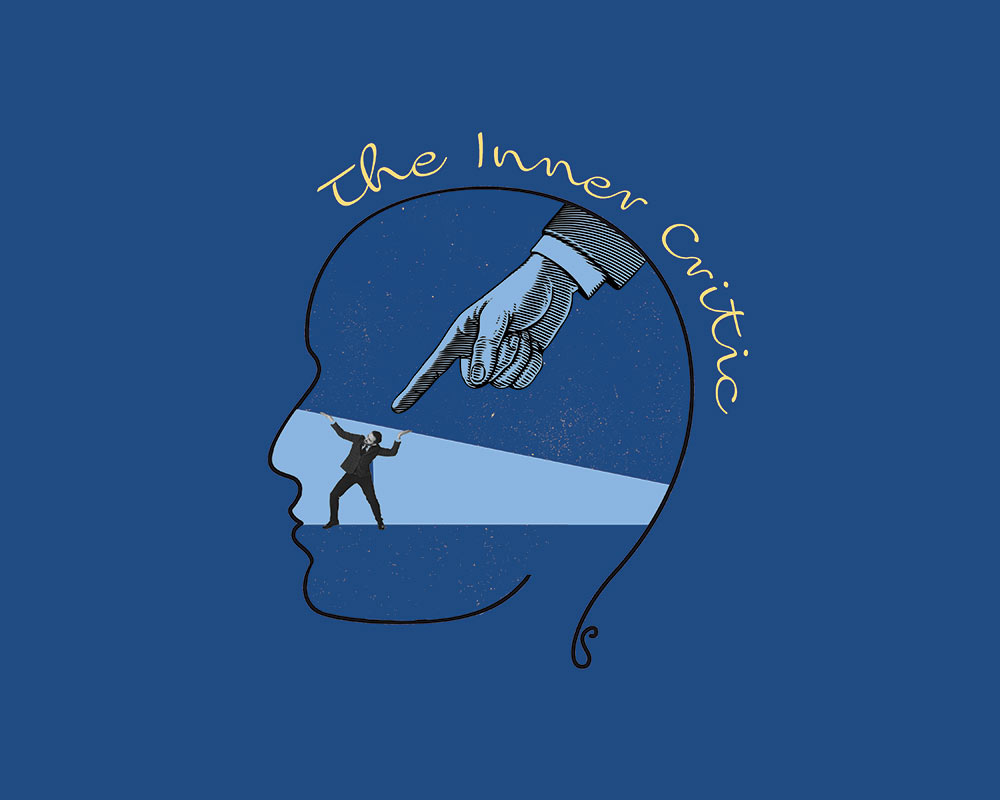
Most people know the voice of the inner critic well, even if they have never given it a name.
It shows up in the morning when you look in the mirror. It arrives uninvited after a difficult conversation at work, replaying every word you wish you had said differently. It is there when you eat something you told yourself you would not eat, when you lose your temper with someone you love, when you fall short of something you were certain you should have been able to manage.
It is the voice that says you are not enough. That you should have done better. That other people do not struggle the way you do. That something, at the core of you, is simply wrong.
Psychologists call it the inner critic. And if you have ever wondered why you are so hard on yourself, the answer is more interesting, more human, and more hopeful than you might expect.
The inner critic is not a character flaw. It is not evidence that you are broken or beyond help. It is a part of you, and like most parts of us, it developed for a reason.
In Internal Family Systems (IFS) therapy, a model developed by Dr. Richard Schwartz, the inner critic is understood as a protective part of the self. It emerged, often very early in life, with a genuine intention: to keep you safe. If you could criticize yourself before anyone else did, the logic goes, you might avoid rejection, failure, or punishment. If you held yourself to an impossibly high standard, you might stay acceptable in the eyes of the people you needed most.
That is not pathology. That is adaptation.
The problem is not that the inner critic exists. The problem is that it often keeps running the same program long after the circumstances that created it have changed. The child who learned that being imperfect meant losing love grows into an adult who cannot make a mistake without a withering internal verdict. The person who was shamed for taking up space learns to preemptively diminish themselves before anyone else can.
The inner critic is loud, and it is persuasive. But it is not the truth about who you are.
Understanding the inner critic means understanding where it learned to speak.
Self-criticism is not randomly distributed. It has roots, and those roots are relational. The way we learn to speak to ourselves is shaped, in large part, by how we were spoken to and how we were treated in the relationships that mattered most to us early in life.
When a child grows up in an environment where love feels conditional, where approval has to be earned, or where mistakes are met with criticism, shame, or withdrawal, they learn to internalize that critical voice. They take it in and make it their own. Over time, it stops feeling like something that was done to them and starts feeling like simply the truth.
Attachment research has long established that our earliest relationships shape what psychologists call our internal working models: the deeply held beliefs we carry about our own worth, our lovability, and our safety in the world. A child who receives consistent warmth and attunement tends to develop a relatively secure internal relationship with themselves. A child whose emotional needs are met with unpredictability, criticism, or dismissal often develops a much harsher one.
This is what we mean when we talk about emotional inheritance. The inner critic is frequently not a voice you invented. It is a voice you absorbed, often before you had the language to question it.
And that matters enormously, because it means the inner critic can be understood, worked with, and transformed. It is not a permanent feature of who you are. It is a learned response, and learned responses can change.
Dr. Angela Derrick notes, “Many clients are surprised when the therapist doesn’t believe that their inner critic is the “truth” about them. They come to therapy with such entrenched patterns of thinking that feel like truth, with a capital T! It can take some time to help clients see that their beliefs about themselves were formed over time by reinforced thought patterns and therefore can be changed. A very rewarding part of the work is helping clients truly start to see themselves differently and relate to themselves more kindly.”
Because the inner critic can take so many forms, it is worth naming some of the ways it commonly shows up in daily life. Not all self-criticism announces itself loudly. Some of it is quiet, habitual, and so familiar that people no longer notice it is happening.
You might recognize the inner critic in thoughts like these:
I should be further along by now. Everyone else seems to have it together. Why can I not just be normal about food? I am so lazy. I ruined everything. I do not deserve to take up this much space. I knew I would fail at this. If people really knew me, they would not like me.
It can also show up in behaviors: the reflexive apology for things that do not require one, the inability to receive a compliment, the compulsion to work harder and harder as proof of worth, the tendency to minimize your own needs while attending carefully to everyone else’s.
In our clinical work, we often notice that the inner critic is loudest in the areas of life where someone feels most vulnerable. For many of the people we work with at SpringSource, that vulnerability is concentrated around food, the body, and weight. The inner critic in eating disorder recovery is particularly relentless, and particularly destructive, because it reinforces the very shame and perfectionism that fuel disordered eating in the first place.
Research confirms what clinicians have observed for years: self-criticism is a transdiagnostic factor, meaning it appears across a wide range of mental health conditions, including mood disorders, eating disorders, anxiety, and trauma. It is not a symptom of one particular struggle. It is woven through many of them. And critically, high levels of self-criticism have been associated with poorer outcomes in psychotherapy, not because those people cannot heal, but because the inner critic actively resists the healing process.
One of the most important things we want to say in this piece is that a busy, productive, high-functioning life offers no protection from a punishing inner critic. In fact, for many high-achieving adults, the inner critic is part of what drives the achievement in the first place.
The person who rises early, works long hours, and rarely allows themselves to rest may be operating, at least in part, from an inner critic that equates stillness with failure and productivity with worth. The perfectionist who rewrites emails three or more times before sending, who cannot delegate because no one else will do it correctly, who lies awake at night reviewing the day for mistakes, is often not simply ambitious. They are exhausted by a voice that will not let them be enough.
This is something we see frequently in our work with midlife adults, and particularly with women navigating the compounded pressures of career, caregiving, relationships, and the physical changes of perimenopause and beyond. The inner critic in midlife often carries decades of accumulated evidence: every perceived failure, every relationship that did not work out, every body that changed in ways the culture deemed unacceptable.
At SpringSource, we have seen many high-achieving adults who have spent years using accomplishment as a way to quiet the inner critic, only to find that it never quite works. There is always another standard to meet. Therapy can offer something different: not a quieter critic, but a different relationship with the critic altogether.

Most people’s first instinct when they become aware of their inner critic is to try to argue with it, override it, or silence it through willpower. This makes sense. But it rarely works, and often makes things worse.
In Internal Family Systems terms, the inner critic is a protective part that believes it is keeping you safe. When you try to forcibly eliminate it, it tends to dig in harder. It has a job to do, and it will not stop doing that job simply because you have decided it is unhelpful.
This is one of the reasons shame spirals are so common and so exhausting. The inner critic says something harsh. You feel ashamed of yourself for having such a harsh inner critic. The critic then criticizes you for feeling ashamed. And the cycle continues, feeding itself.
A 2025 study published in BMC Psychology that examined self-critical cycles in depth found that the most effective copers were not people who had silenced their inner critic. They were people who had learned to relate to it differently, approaching it with curiosity and self-compassion rather than combat.
That distinction is at the heart of how we approach this work at SpringSource.
The goal in therapy is not to eliminate the inner critic. It is to understand it, build a relationship with it, and gradually help it relax its grip.
In IFS-informed work, this means approaching the inner critic as you might approach a frightened or exhausted child who has been working too hard for too long. Not with dismissal, and not with surrender, but with genuine curiosity. What are you afraid would happen if you stopped? What were you trying to protect?
When the inner critic is met with that quality of attention, something often shifts. The part begins to reveal what is underneath it, usually an exile, a younger, hurt part of the self that carries old pain, old shame, and old beliefs about not being enough. The critic has been standing guard over that exile, making sure no one gets close enough to see it. When the guard begins to trust that the Self can handle what is underneath, it can begin to soften.
This is deep, meaningful work. It does not happen overnight. But it produces a different kind of change than trying to think your way out of self-criticism. Compassion-focused approaches consistently show that the shift from hostile self-criticism toward compassionate self-understanding changes not just what people think about themselves, but how they feel about themselves at an emotional level. That emotional shift is where lasting change lives.
When working with someone whose inner critic has been running the show for decades, the first goal is always to help them get curious about it rather than ashamed of it. The critic is not the enemy. It is a part of them that has been working incredibly hard, often since childhood, and it deserves to be understood.
At SpringSource, our approach to the inner critic does not begin and end with parts work. It is woven through the relational and psychodynamic framework that underpins our philosophy.
Psychodynamic therapy invites us to look at the origins of the inner critic honestly and compassionately. Where did this voice come from? Whose voice does it echo? What would it have meant, in the family or environment you grew up in, to simply be enough without doing anything to earn it?
These questions are not always easy to sit with. But they tend to open something up. When you can trace the inner critic back to its origins, to a parent who criticized freely, a home where love felt conditional, or a culture that gave you endless messages about your body, your worth, or your place in the world, it stops feeling like the simple truth about who you are. It starts feeling like something that happened to you. That shift, from self-blame to understanding, is where a great deal of healing begins.
The relational dimension of this work also extends to the therapeutic relationship itself. For many people, the experience of being met with consistent curiosity, warmth, and non-judgment by a therapist is genuinely new. Over time, that relational experience begins to offer an alternative to the inner critic’s verdict. It does not just teach people to think differently about themselves. It gives them the felt experience of being treated as worthy, which is often where the deeper healing begins.
You do not need to wait for therapy to begin noticing the inner critic. Here are a few gentle starting points.
Simply notice it. The next time you hear a harsh internal voice, pause and name it. “That is my inner critic.” You do not need to argue with it or silence it. Just observe it, the way you might notice a weather pattern passing through.
Get curious rather than combative. Instead of telling the critic to stop, try asking it a question. What are you worried about? What are you trying to protect me from? You may be surprised by what comes up.
Notice the origin. When the critic speaks, does it remind you of anyone? A parent, a teacher, an old relationship? Recognizing that the voice has a source outside of you can create a little distance from it.
Practice a moment of self-compassion. Not a forced affirmation, but a genuine acknowledgment. This is hard. I am doing my best. I am allowed to be human.
Consider therapy. If the inner critic is loud, relentless, and interfering with your relationships, your work, your relationship with your body, or your quality of life, that is important information. It is not a sign that you are broken. It is a sign that a part of you needs more than a self-help exercise can provide.
The inner critic is one of the most universal human experiences there is. It appears across cultures, across diagnoses, and across life stages. It is not unique to you, and it is not proof that something is wrong with you.
It is a part of you that learned, somewhere along the way, that being hard on yourself was the safest option available. That learning made sense once. It may not be serving you now.
At SpringSource: Eating, Weight & Mood Disorders, we work with the inner critic across many clinical contexts: in eating disorder recovery, where self-criticism fuels the shame that keeps people stuck; in depression and anxiety treatment, where the inner critic amplifies suffering; in work with high-achieving midlife adults who are tired of never feeling like enough; and in GLP-1 mental health support, where the inner critic often becomes louder as the body changes.
Whatever brings you here, the work is the same at its heart. Learning to relate to yourself with the same compassion you would offer someone you love.
That shift is possible. We see it happen every day.
If you would like to explore this work, we invite you to reach out. We offer a free 15-minute consultation and would be glad to help you find the right level of support.
Call us at 224-202-6260, fill out our contact form, or schedule your free consultation online.
Recovery and relief are always within reach.



We provide in-person therapy in Northbrook and Chicago, with telehealth therapy available throughout Illinois.
© 2026 SpringSource: Eating, Weight & Mood Disorders | Designed by 800Commerce
Serving: Chicagoland Area, Northbrook, Evanston, Arlington Heights, Glenview, Skokie, Palatine, Elgin, Cicero, Schaumburg, Des Plaines, Orland Park, and throughout Illinois