
Written by: Angela Derrick, Ph.D. & Susan McClanahan, Ph.D.
Date Posted: November 12, 2025 7:04 am
Article by Edward T. McDougal
I’ve known Susan McClanahan since our kids played tournament chess together starting in 2003. Our families traveled all over the country to participate in national tournaments that drew thousands of elementary and middle school players from all over the country. While our boys battled the nation’s best junior opponents, we parents stationed ourselves behind windows outside the tournament hall, steadying our nerves with conversations about chess and life as our daughters played with dolls or did art projects together. Four hours might pass before we’d catch a thumbs up or down through the glass, then rush to shower our children with affection for their stamina and spirit, regardless of outcome.
Over the years, I’ve come to know Susan as an incredible mom and wife, and through my wife who partners with her, as a thoughtful, strategic, and deeply humane psychologist and businesswoman with a very big and generous heart. But doing this interview with Susan uncovered some unexpected insights I am eager to share.
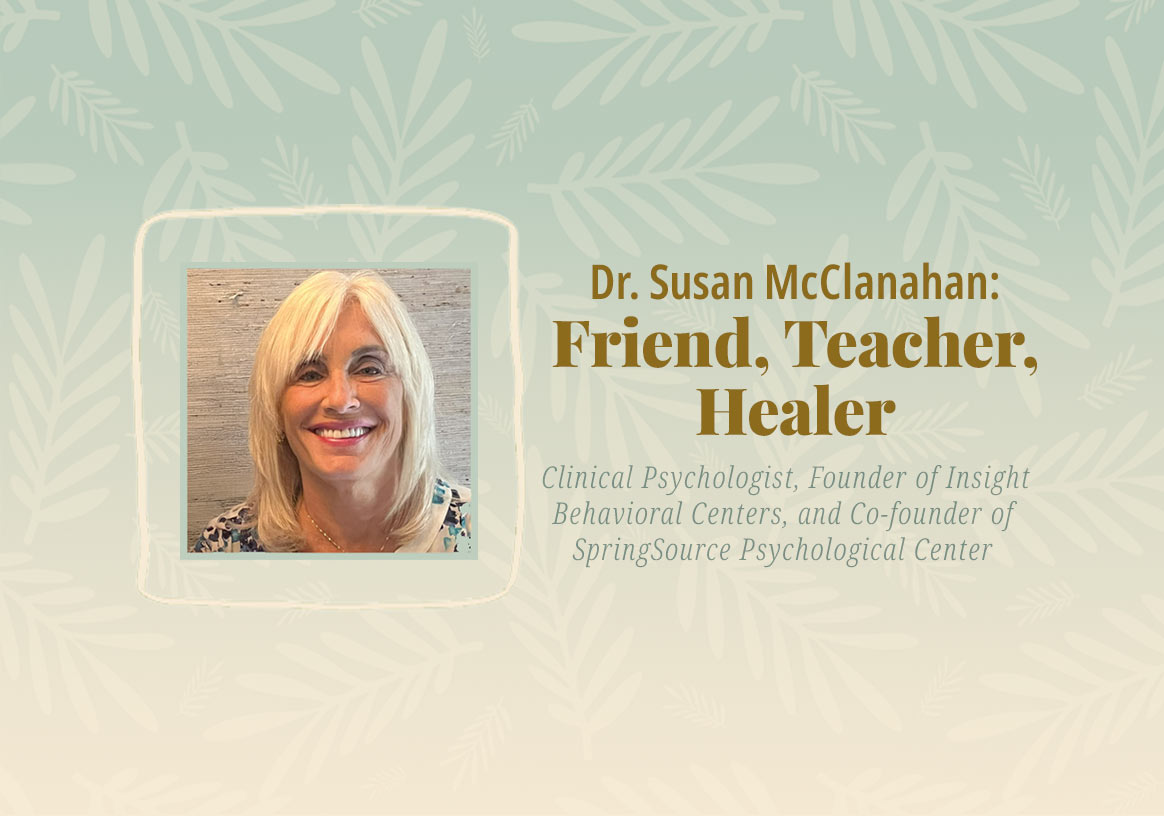
Dr. Susan McClanahan founded Insight Behavioral Health Centers in 2004, creating Chicago’s first intensive outpatient and ultimately residential program for eating, mood, and anxiety disorders. She served for several years as Chief Clinical Officer at Eating Recovery Center and later she co-founded SpringSource Psychological Center, now SpringSource: Eating, Weight & Mood Disorders. She has taught and supervised students for more than twenty years as a clinical instructor in Northwestern University Feinberg School of Medicine’s Department of Psychiatry and Behavioral Sciences and has earned numerous awards including Chase Bank’s Businesswoman of the Year.

Her story begins in an unlikely place for someone who would become a pioneer in eating disorder treatment: in the shadow of the Holocaust. Susan grew up in New Jersey, the daughter of Hungarian Holocaust survivors whose lives shaped how Susan sees the world.
Her parents arrived in America in 1956 during the Communist uprising, carrying their two-and-a-half-year-old son and absolutely nothing else. “My father always saw America as the greatest place you could ever want to be. He was a patriotic American until he died at almost 97.”
But beneath her parents’ forward-looking optimism lay something else, something that seeped into the next generation in ways no one quite understood at the time.
“In the last 10 or 15 years, there’s been a lot of discussion in our field about intergenerational transmission of trauma. And when I was growing up, we didn’t think that way. We kind of thought, well, you know, the next generation didn’t go through what that generation had gone through. So what is there to complain about and what is there really to suffer about?”
“I always said, oh, I have such a small family,” Susan recalls. “And it really wasn’t until recently that I thought, well, I have a small family because everyone was killed.”
The realization carries weight—not self-pity, but a profound recognition of absence, of stories never told, of aunts and uncles and cousins who exist only as missing branches in the family tree.
As Susan’s parents focused on building their new American lives, they didn’t have time or resources to process their psychological trauma. “So in some ways, I think it fell on the next generation to work through the meaning of all of that,” Susan says. This intergenerational transmission of trauma—now widely discussed in psychology but barely understood when Susan was young—became the invisible motivator that would give her a deep sense of caring for people who carried impossible burdens of immense pain.
She became a helper from day one, trying to ease life for parents who had already endured the unendurable. Where her father built a clothing business in New York, Susan felt called to something different. “I wanted to do something meaningful. I felt like maybe given the atrocities that had happened to them, I just kind of had a seriousness of myself, maybe at an early age, and appreciation for resilience and being able to overcome something terrible and have a beautiful life.”
Her closeness to her parents’ trauma opened her heart to patients who endured the worst types of suffering. “I was never afraid of the patients who were in the most pain or struggling the most. In fact, I was kind of most attracted to that, more than just your average little bit of suffering. People who had had trauma, sexual abuse, just really difficult things happened to them in their life. That was sort of the population I was lead to support and care for. And also people with real depth and capacity to look deeply inside themselves and the world.”

Susan knew her path early. At twelve or thirteen, after hearing about a friend’s father who was a psychiatrist, she understood she wanted to become a clinical psychologist—a role that would let her be both teacher and healer, combining research, academia, teaching, and counseling.
The journey took her to Duke University—chosen, she admits, for its warm weather, beautiful campus, and her parents’ requirement that she stay within driving distance of New York. After a detour as a paralegal at Sullivan and Cromwell in New York, she went on to pursue a master’s degree in developmental psychology from Columbia University. There she studied early infant attachment under John Bowlby’s theories, examining how parent-caregiver interactions form the foundation for mental health.
At Columbia, Susan was drawn to psychologist and feminist Carol Gilligan, whose book In a Different Voice made a life-changing impact on Susan’s understanding of women’s mental health. “I started to see how women had a different voice that was less focused on autonomy and more focused on connection and nurturing others. So just a little bit of a different language for what mental health meant—connection as opposed to autonomy, nurturing as opposed to independence.”
Thirty years later, Susan would meet Gilligan by pure chance at an Indian restaurant in Chicago. “I almost fell over,” she remembers, finally able to tell her hero how much she had inspired a young student decades earlier.

At twenty-six, Susan moved to Chicago for her PhD at Northwestern University. “I had to support myself, so I coached kids, high school kids, and also graduate students for SATs and GREs and LSATs and that kind of stuff. So I did a lot of teaching too.”
Her dissertation took her to Cook County Jail for two and a half years, interviewing women to study child sexual abuse as a precursor to prostitution.
“I really saw what the legal system was like and what it was like for women who were in jail for having engaged in prostitution and retail theft because they were trying to support their families. We looked closely into the mental health of these people, trying to find out clues that might help us understand what caused their downward spiral.”
Working with professor Linda Teplin on the criminalization of the mentally ill, Susan discovered that about thirty-five percent of women who ended up as prostitutes had experienced sexual abuse.
“It was such a meaningful experience and not scary at all. The women were basically down and out and they had very difficult histories and very difficult things to overcome. And so that was really an incredible experience to get to work with those women. So I just found myself being geared toward wanting to work with women with a lot of trauma.”
Susan’s path to eating disorders came almost by accident. During her postdoctoral year, she joined Northwestern’s People at Risk program for overweight and morbidly obese patients, work that interested her because her own mother had struggled with weight management. What she found stunned her: that beneath each hurting patient lay a person with a deep, complex background underlying the weight issues.
“There were a lot of reasons why people might want to protect themselves by having a larger body,” she explains. “This was the era of Optifast, when Oprah Winfrey and others lost dramatic weight on eight-hundred-calorie diets, only to gain it all back with crushing shame.”
The arrival of phentermine and fenfluramine transformed how clinicians approached weight loss treatment. Susan remembers a four-hundred-pound patient who described driving home from his downtown Chicago office to Naperville. “He said for the first time in his life, he didn’t think about stopping at a fast-food place on his way home. And he got to his front door and he hadn’t been thinking about dinner.” The medication had quieted what he called the “food noise” in his head—the constant compulsion to eat.
“I just thought this is so biological,” Susan says. “People who are overweight, they face not only psychological challenges, but real biological barriers—their bodies actually resist maintaining lower weights. It is much harder for them to be thin.” The revelation that weight wasn’t about willpower or moral failure but about brain and body chemistry shifted her entire understanding of weight loss.
When fenfluramine proved to cause heart disease, doctors had to stop prescribing the medication that had finally given many patients genuine relief from their weight struggles.
The tragedy of watching her patients return to their hopeless struggle deepened Susan’s commitment to specifically addressing the needs of people with eating disorders.
By her early thirties, Susan was working with eating disorders at Northwestern, seeing forty to forty-five private practice patients weekly. She loved the work but felt constrained. “I wanted to make a bigger impact. I know I can make an impact one on one and that is huge. If you help one person and then they are a better parent and a better community member and everything else, it makes an enormous difference. But I wanted to help more people.”
The solution came from an unexpected source. Angela Derrick, who had been Susan’s postdoctoral student at Northwestern, mentioned that two psychologists in Atlanta had started their own eating disorder program. “And I thought, wow, a psychologist can do that? I thought this can only happen in a hospital.”
Susan had been treating severely anorexic and bulimic individuals that required specialized care outside of Illinois. They’d start to recover at these out-of-state facilities, then regress after returning to Chicago where the specialized care was not yet available.
“I realized there just wasn’t anything in the Chicago area that was equipped to give them the care they needed. So after I talked to Angela, I thought, okay, you know what? We don’t have anything in Chicago, and I’m really, really tired of sending people away. And I procured a comfortable workspace and said, why don’t we start an IOP (Intensive Outpatient Treatment Program)? And it’ll be nine hours a week. People can come for a meal, a skills group, and a process group. And so that’s what I did. And Angela was one of my first therapists.”
Susan started an outpatient program that was immediately successful—nine hours a week with meals, skills groups, and process groups.
After a chance meeting with Susan at a chess tournament, my wife Nevila was brought on to help with the huge increase in administrative work that accompanied the burgeoning growth of their practice. What became Insight Behavioral Health Centers grew from that single treatment room into Chicago’s first Intensive Outpatient Program for eating, mood, and anxiety disorders.
But there is something that Susan regards as a greater accomplishment than leading her organization to the overnight growth of what would shortly become the largest eating and mood and anxiety disorder treatment facility in the Midwest.
“If I had to say what I’m the proudest of as I look back on my life, a lot of it is the people that I had an impact on in their early careers.”
“We just sort of had the greatest hits of the most amazing therapists,” Susan says. Her hiring philosophy seems counterintuitive in today’s competitive field of eating health centers: “I wanted to hire people who were as good or frankly better than me and had a skill set that I didn’t have. I never felt intimidated. The more talent I could attract, the better.”
One of the things that impresses me most about Susan’s story isn’t the programs she’s built or the recognition she’s won. It’s her unwavering belief that there’s enough success to go around, the belief that helping her employees succeed even after they quit working for her doesn’t diminish her own work. This philosophy springs from her conviction that the people she serves—patients and staff alike—possess an intrinsic value that her job is simply to help them discover. Susan actively encourages her employees to follow their dreams, even when those dreams mean leaving her clinic to start practices that might eventually become her competition.
“I just wanted to make it possible for them to do what they wanted to do. I would ask them, ‘What’s your dream? What kind of program do you want to build?'”
When I asked why someone leading the region’s most innovative and comprehensive eating disorder program wouldn’t require employees to sign non-compete clauses, Susan seemed genuinely puzzled by the question. “I’ve never really felt proprietary,” she explains. “If something’s working and even business-wise, too, I just want to help people to achieve their goals. I think I always felt that there is room in the field for anyone. And why would you want to have fewer people doing great things in the world?”

Look around Chicago’s mental health landscape today, and Susan’s influence appears everywhere. Chelsea Hudson founded Cityscape after working at Insight. Dr. Danielle Doucette and Dr. Mimi Neathery helped build Midwest Counseling and Diagnostics as Insight alumni. Audrey Grunst launched Simply Bee, specializing in children and adolescents, after learning under Susan’s guidance. There’s also Dr. Sarah Sanders, who created Allow Wellness, and Aga Grabowski and Chrissy Ellis, who built Wildflower Center for Emotional Health. Dr. Julie Friedman and Laura Lang at Skyway both trace their professional roots to Insight, and the list goes on and on.
And here’s the twist—the unexpected outcome of Susan openly empowering her employees to follow their dreams: “I think ironically, you do end up with a lot of people who are really loyal to you because they recognize that about you. And then, you know, if they’re with you in their twenties for five, seven, ten years, like it just makes sense that they’re going to want to go off and do something on their own. And it’s so fun and amazing to see what they have done.”
Susan approaches marketing as she does therapy—by finding the hole in the field, the niche nobody else is filling, the need left unaddressed. “I don’t want to repeat and compete,” she says. Where others battle for the same contracts, she looks for open ground. “In mental health it’s just not like that, or that’s not how I see it.”
In an era of private equity takeovers, publicly traded mental health companies, and multimillion-dollar therapy business launches, Susan and Angela chose something different for SpringSource: intimate, exceptional, individualized care while genuinely caring for each individual.

Success in mental health doesn’t shield you from its unforeseen challenges. Susan faced a difficult split with a business partner that felt “almost like a divorce.” “The other partner was in a better financial position than I was, and it looked quite possible that we would lose everything.”
“I basically found a way to keep Insight and buy out my partner,” Susan says. “My entire life was in debt.” She got the biggest loan Chase Bank would give her, mortgaged her house, borrowed from her elderly father’s savings, and asked friends and family to invest. “I really wasn’t afraid because I had so much confidence and passion in what we were doing that it just felt like the right thing.”
During this crisis, she won Chase Bank’s Businesswoman of the Year award—a recognition that surprised her. “I never really had thought of myself as a business person. I just thought of myself as a psychologist with a practice.” Her financial goal when starting Insight Behavioral Health? To make twenty-five thousand dollars a year when she wasn’t present, so she could take vacation without losing income. “Maybe that’s really naive, but money wasn’t what it was about for me.”
A year after buying out her partner, she partnered with Eating Recovery Center and Dr. Ken Wiener, moving into residential treatment. As Insight’s patients grew sicker and required more medical intervention, she felt it was time to partner with psychiatry and medical professionals. The partnership lasted several years, but COVID pulled her back to basics.
“COVID made me feel like I want to go back to my roots and be a therapist again.” For seven years she’d been running operations and business as Chief Clinical Officer at Eating Recovery Center, supervising rather than doing therapy.
She once again reached out to Angela, and together they started SpringSource Psychological Center in 2020. A year later, they brought Nevila back into the fold. SpringSource started from scratch like Insight once did—no fancy props, no sophisticated marketing.
“We have two beautiful spaces—each with four offices. We want to spend our money on great staff and programming and teaching and training. And, you know, we have a vision that we’ll get to where we need to be.”
Beneath all Susan’s work lies a surprisingly simple philosophy that inspires relationship with staff and patients, rooted in the psychoanalyst D.W. Winnicott’s concept of the “true self.”
“I think everybody has intrinsic value and I want people to see that within themselves, that they matter, that they’re valuable, that they’re important,” Susan explains. Many patients never had early environments where they felt this way from parents or mentors. “Although it’s really interesting, I think it can take just one person.”
She’s seen it repeatedly: someone from difficult circumstances will say there was one person who gave them hope, who made them feel they could move forward. “One person can make such an enormous, enormous difference. And it’s such an honor to be able to work so deeply with someone.”
Her therapeutic approach focuses less on skills and didactics than on uncovering what’s already there. “There’s sort of a true self in there,” she says, referencing Winnicott’s distinction between true self and false self. “The false self might be the part of you that has defenses and has to kind of cover up to exist in the world. And the true self is what you really want to get to, which is your authentic self, who you are, what you’re here for, what your purpose is.”
This connects to Viktor Frankl’s logotherapy and the search for meaning. “That’s love and work. That’s what it’s about.”
She cites the recovery story model used in Alcoholics Anonymous—the power of hearing “I did it. You can too.” But Susan’s version wouldn’t be about boasting. “Not like, oh, I’ve done great things, but I’ve eked out a life that feels valuable and meaningful. And I feel like everyone can do that and can heal and recover.”
“I don’t feel judgment,” Susan says when I ask if patients sense her perspective. “If someone is struggling, there’s a reason they’re struggling. And sometimes it might be some biological factors too, but that we can always get—I have a lot of hope.”
Hope, not happiness, drives her work. “That’s my job as a therapist is to hold on to the hope when my patients don’t have hope. And now with so many years of experience, I really can hold onto the hope in a very authentic way because I’ve seen incredible, incredible healing.”
Currently, Susan isn’t resting on her legacy. She’s tackling what she sees as an emerging need that the eating disorder field has, in its well-meaning efforts, failed to address.
The field has embraced body positivity, Health at Every Size, and non-diet approaches to help people in larger bodies avoid shame. But Susan noticed something troubling: patients in larger bodies who genuinely wanted to lose weight felt they couldn’t admit it. “They would be going to Weight Watchers without telling us. So they were trying to lose weight, but they didn’t want to tell us they were trying to lose weight because they knew or thought we wouldn’t be supportive.”
The eating disorder community has become so concerned with avoiding weight stigma that certain words—obesity, weight management, compulsive overeating—have become nearly forbidden. “People get canceled for using that language,” Susan says. “And it’s very hard to attract that population that very much needs our help without being able to say obesity, without being able to say weight management. So somehow in our efforts to support inclusivity we’ve actually ended up excluding people.”
The arrival of GLP-1 medications like Ozempic, Wegovy, and Tirzepatide—a new class of drugs that suppress appetite—can now safely help patients lose significant weight and keep it off. Susan sees enormous potential in these medications, recalling the fen-phen era thirty years ago when she first witnessed medication quieting the relentless “food noise” in patients’ brains—the constant mental chatter about food that drove compulsive eating. For the first time, Susan feels that patients can safely experience what it feels like to move past thinking about their next meal and realistically achieve long term goals of healthy weight management.
“I think for people who meet the medical criteria for being on the GLP-1s there’s enormous potential for people to feel like themselves again,” she says. But she worries about the psychological aspects of patient care that are being ignored.
Patients lose weight, return to their doctors in three months for celebration, but never address the emotional issues. “Food can be a drug for many people. So it’s almost like quitting alcohol. Like all of a sudden, there isn’t the same excitement and pleasure around food, which is a relief, but also a huge loss too.”
At SpringSource: Eating, Weight & Mood Disorders, Susan hopes to work with people on these medications who want to address the psychological and emotional dimensions of weight loss—the grief, the vindication, the complicated feelings about missed time and new possibilities.
Susan and Angela are also focusing on midlife and beyond, an underserved population in eating disorder treatment. “Just because you’re forty-five, fifty, sixty, seventy, eighty years old doesn’t mean there isn’t room for growth,” Susan insists. “There isn’t a deadline for when you’re done working on yourself and your psychological and emotional being.”
Most developmental theories focus on early life. But Susan sees profound impact possible in later years, when people have perspective, resources, and—perhaps—the courage to finally address what they’ve been avoiding.
Now, a bit about Susan’s life outside work. Susan lives in Northbrook with her husband, Glenn. They have three adult children—Gavin, Bryce and Emily. Susan’s parenting philosophy mirrors her therapeutic approach: “I try not to get in their way and let them be who they are, similar to how I am with my patients. But of course, giving mentoring and teaching and opportunities and life lessons.”
Susan’s three children—Gavin, Bryce, and Emily—all became nationally recognized chess players during their elementary and middle school years, though she and her husband Glenn never planned it that way. Gavin discovered chess online at five and taught himself, eventually teaching his brother, who was three and a half. Emily, the youngest, got dragged to tournaments and eventually became formidable herself.
Glenn, also a psychologist with an MBA from his earlier career, became “a very, very supportive husband and also someone who’s an amazing dad and very involved with the kids. And I don’t know how I could have done life without him.”
Susan’s ninety-five-year-old mother Eva lives with her now—the same woman whose challenges in weight management sparked Susan’s interest in obesity research decades ago. Eva remains remarkably vigorous. I remember her dancing at Bryce’s bar mitzvah like someone half her age.
“I have taken up pickleball, which I really, really enjoy. So that’s been—that’s been a great thing. I played field hockey in college. I was an athlete a lot of my life. So it’s really fun to be able to play a sport that’s somewhat competitive, but also very, very social. I do yoga, which I also really, really enjoy. And I’ve been reading and kind of getting back to, I don’t know, reading, learning, doing some writing, traveling.”
Susan wants to write a book—several, perhaps. “I think just about hope and healing and resilience and how everyone can recover and how there’s a richness and a depth to every human being and that it’s already in there and just to uncover the layers kind of like an onion and find who you truly are.”
She imagines sharing her own biography, her struggles with anxiety and depression, her journey to healing. “Just to read someone’s story where they actually healed and recovered can be so helpful for people who are still struggling.”
The world has changed dramatically for mental health practices. Susan finds herself in unfamiliar territory: the world of social media influencers, many of whom “really don’t know the first thing about mental health.” She and Angela wonder about podcasts, video content, ways to reach larger audiences with their decades of expertise.
One of her favorite quotes comes from Tom Robbins’ novel Still Life with Woodpecker: “It’s never too late to have a happy childhood.” “You can heal and grow. And there’s a person inside you that can become the person you have always wanted to be, no matter what your circumstances are.”
“There’s a self, there’s a soul, there’s a person in there that has—there’s meaning for why they’re on this earth,” Susan says. “My feeling was we can get to that core person by helping them work through the many difficulties perhaps that they had, and that the essence of who they are is what I wanted to have them experience and have that part of themselves come alive.”
For someone whose childhood was shadowed by history’s darkest chapter, who grew up helping parents rebuild from utter loss, this philosophy feels both personal and universal. Her parents never had time to process their trauma, so Susan made processing trauma her life’s work. They modeled resilience without bitterness, gratitude without naiveté. She’s spent four decades helping others find that same capacity within themselves.
I approached this interview eager to explore the life of someone who has been a close family friend for twenty-two years. Until now, my admiration for Susan has centered almost entirely on her gifts as a mother and wife rather than on the particulars of her professional success.
My understanding of Susan’s professional life has come secondhand through my wife, who has shared countless stories of Susan’s skillful leadership at Insight and SpringSource. I approached this interview always wanting to understand how her personal philosophy balanced exceptional motherhood with building a legacy in eating health—a question this conversation has finally answered.



We provide in-person therapy in Northbrook and Chicago, with telehealth therapy available throughout Illinois.
© 2026 SpringSource: Eating, Weight & Mood Disorders | Designed by 800Commerce
Serving: Chicagoland Area, Northbrook, Evanston, Arlington Heights, Glenview, Skokie, Palatine, Elgin, Cicero, Schaumburg, Des Plaines, Orland Park, and throughout Illinois